Worker runtime
Scoped tools, task state, retries, delegation and worker identity.

AIRO11 One brings specialized AI workers, workflow intelligence, contextual knowledge and operating controls together around enterprise business processes.
Explore Interactive ExamplesChoose a business case and inspect each worker action, evidence check and approval gate.
Open execution workbench ↗Explore fictional enterprise cases. Every action changes the workspace state; human approval is required before resolution.
Customer challenges a merchant transaction; assemble transaction, card and policy evidence.
Authoritative reference: Reg E dispute intake and evidence verification
Evidence check: 1 document(s) missing
Human gate: Approval required before execution
Example experience with fictional records. No live customer, financial, insurance or clinical transaction is performed.
Capabilities are organized by the role they perform in enterprise service outcomes.
Customer and employee touchpoints.
Agents, decisions and governed context.
Task work, case resolution and workflow.
Policy oversight, quality and observability.
Each application has a defined role. Commercial availability and deployment scope are confirmed in a customer engagement.
Orchestrate specialized agents, skills and enterprise processes.
Bring conversational voice intelligence into customer journeys.
Connect contact center journeys, channels and enterprise context.
Manage accountable digital workers and task execution.
Coordinate governed multi-step workflows and handoffs.
Support knowledge-grounded analysis and decisions.
Connect governed enterprise knowledge and data.
Design, test and evaluate AI workflows and agents.
Apply policies, approvals, observability and trust.
Measure performance, service quality and outcomes.
Coordinate complex cases with evidence and closed-loop actions.
Explore Resolve ↗Design integration around existing contact-center services, systems of record, event streams, identity platforms and approved enterprise data sources.
Worker orchestration is useful only when evidence, permissions, model decisions and human authority are observable.
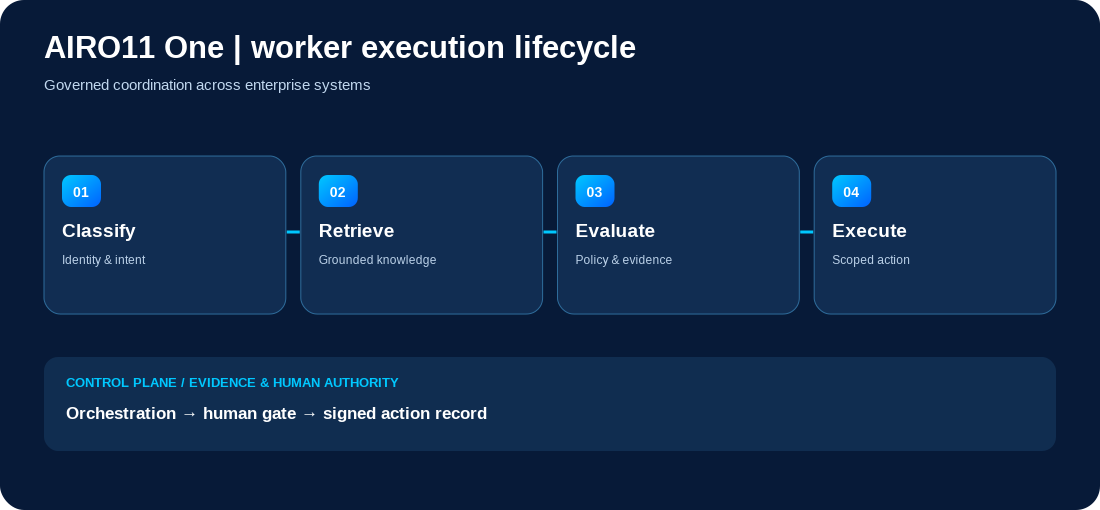
Scoped tools, task state, retries, delegation and worker identity.
Source citations, access-filtered retrieval, model evaluation and context controls.
Policy enforcement, approval boundaries, execution traces and accountable outcomes.